
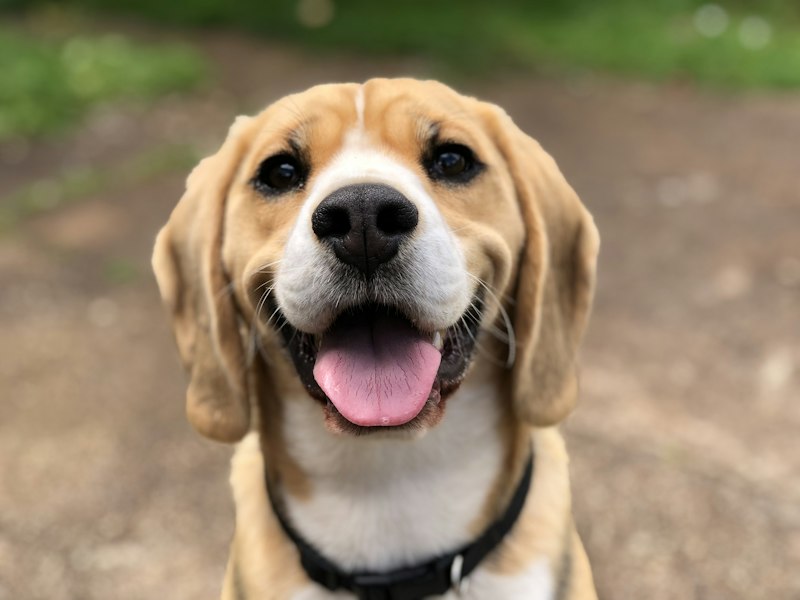
Why Drumkeeragh works for a dog with stiff hips
Drumkeeragh Forest sits in the hills on the Ballynahinch side of the Dromara area, and it's one of those County Down forests that doesn't get mentioned in the same breath as Tollymore or Castlewellan — which, if you're walking an older dog, is rather the point. It's quieter, the trails are forest roads rather than narrow woodland paths, and there's enough variety in the terrain that you can choose a walk to suit the dog you actually have that day, not the dog you wish you still had.
If you've typed something like dog walks Ballynahinch, County Down into your phone because your usual stretch of grass isn't cutting it any more, Drumkeeragh is worth the short run out from the town. The forest roads are wide and mostly even underfoot, which matters more than scenery once a dog has arthritis — a narrow, rutted path with roots across it is far harder on old joints than a flat stretch of compacted stone, even if the stone is less picturesque.
Where to park, and which entrance is quieter
There's a car parking area near the main entrance, usually with room for a reasonable number of cars, though it can feel tight on a dry Sunday afternoon when half of Ballynahinch has had the same idea. On a weekday morning or in poor weather you'll often have it largely to yourself, which is exactly when a nervous or slow-moving older dog is happiest — no excitable spaniels bouncing past while your dog is still working out where to put its back legs on the way out of the car.
The approach roads are minor country roads rather than anything resembling a main route, so expect single-track stretches, the odd passing place, and the possibility of a tractor or a few sheep being moved between fields. None of this is unusual for this part of County Down, but it's worth building a few extra minutes into your journey rather than rushing a dog out of the car the second you arrive — a slow, unhurried transition from car to path makes a real difference to a dog with sore hips.
How steep does it actually get?
This is a forest on a hillside, so there is genuine climbing to be done if you go looking for it. The ground nearest the car park tends to be the gentlest, and as you follow the forest roads further in, the gradient builds — sometimes gradually, sometimes in short, firmer pulls where the road switches back on itself to gain height. None of it is a scramble; it's all walkable forest road rather than rough hill path, but a dog with hind-end weakness or significant arthritis will feel a sustained climb in a way a younger dog simply won't.
The honest advice is to treat the uphill sections as optional rather than inevitable. Walk out along the lower, flatter ground for as long as your dog is happy, then turn back the way you came rather than pressing on to complete a loop out of stubbornness. There's no prize for finishing the longer route, and a dog that's sore for two days afterwards hasn't had a good walk, however nice the view from the top might have been.
The short loop for a bad day
On days when your dog is clearly stiffer than usual — cold, damp mornings seem to bring this out in older dogs more than anything else — stay on the ground closest to the car park and don't commit to a full waymarked route at all. Walk a little way in along the flattest forest road you can see, let your dog sniff and potter, and simply retrace your steps back to the car once they've had enough. This out-and-back approach, rather than a fixed loop, is the single most useful trick for walking an arthritic dog anywhere, and Drumkeeragh's flatter sections near the entrance make it easy to do.
If your dog is having a good day and wants more, you can always extend a little further before turning back. It's far easier to add distance to a short walk than to shorten a long one once you're committed to a loop halfway up a hill with a dog who has quietly decided they've had enough.
Benches, rests and where to catch your breath
There are usually a small number of picnic benches near the car park area, which is handy for a last sit-down before you load the dog back into the car, or for letting a dog catch its breath before the walk back if you've gone a bit further than planned. What you shouldn't expect is a bench at regular intervals along the trail itself — this is a working forest rather than a landscaped park, and seating along the route can't be relied on.
The practical workaround is to use the terrain rather than furniture. Flat, open stretches of forest road double perfectly well as a rest stop — stop, let your dog stand or lie down on the stone rather than cold wet ground if you can find a drier patch, and give them a minute before moving on. Carrying a lightweight mat or even an old towel in the car for this purpose is a small thing that makes a real difference on a long, slow walk with an older dog.
What the ground is like in February (and the rest of the year)
Forest roads here are compacted stone rather than mud paths, which is good news for arthritic dogs — far kinder on sore joints than the root-and-puddle combination you get in a lot of broadleaf woodland. That said, County Down winters don't spare anywhere, and by February you can expect standing water in the low points of the track, soft churned verges where forestry vehicles have been working, and stretches of loose stone that have been washed partly clear of their finer surface. None of this stops a walk, but it does mean slower going and a dog that needs watching on anything that looks slick.
Spring and early summer are easier going underfoot and tend to be quieter too, before the forest gets much use through the main summer months. Whatever the season, a dog with arthritis will generally do better on a cool, dry morning than in the heat of a summer afternoon, so if you have the choice, walk early.
The honest bits: livestock, forestry work and no bins
Like most working forests in this part of County Down, Drumkeeragh can have forestry operations going on at various times — felling, extraction, that sort of thing — and sections of trail can be diverted or closed while that's happening. Always check current signage at the entrance before you set off, and don't assume a route you walked last month is open or unchanged this month. Livestock in adjoining fields is also a possibility in rural County Down generally, so a dog that isn't reliably recalled is better kept on a lead unless you can see clearly that there's nothing to chase.
There are no bins to rely on here, so bring enough bags for the whole walk and carry everything back out with you. It's a small, unglamorous point, but it's the kind of thing that actually affects whether a walk goes smoothly, which is more useful to know in advance than another description of the view.
After the walk, if you need somewhere for the dog to rest
A slow, low-key walk like this is often all an older dog wants for the day, and a warm, quiet place to sleep it off afterwards matters just as much as the walk itself. If you're ever heading away for a few days and need dog boarding Belfast families trust with an arthritic or elderly dog's routine, that's really the core of what we do at Johnny's Doggy Hotel in Newtownbreda — not far from Carryduff, and a manageable run from Ballynahinch. We're equally used to fitting a gentler, shorter routine around doggy day care near me searches from owners whose dogs just can't manage the long, bouncy walks they once did, and we'd rather hear the honest version of what your dog can and can't manage than guess.