
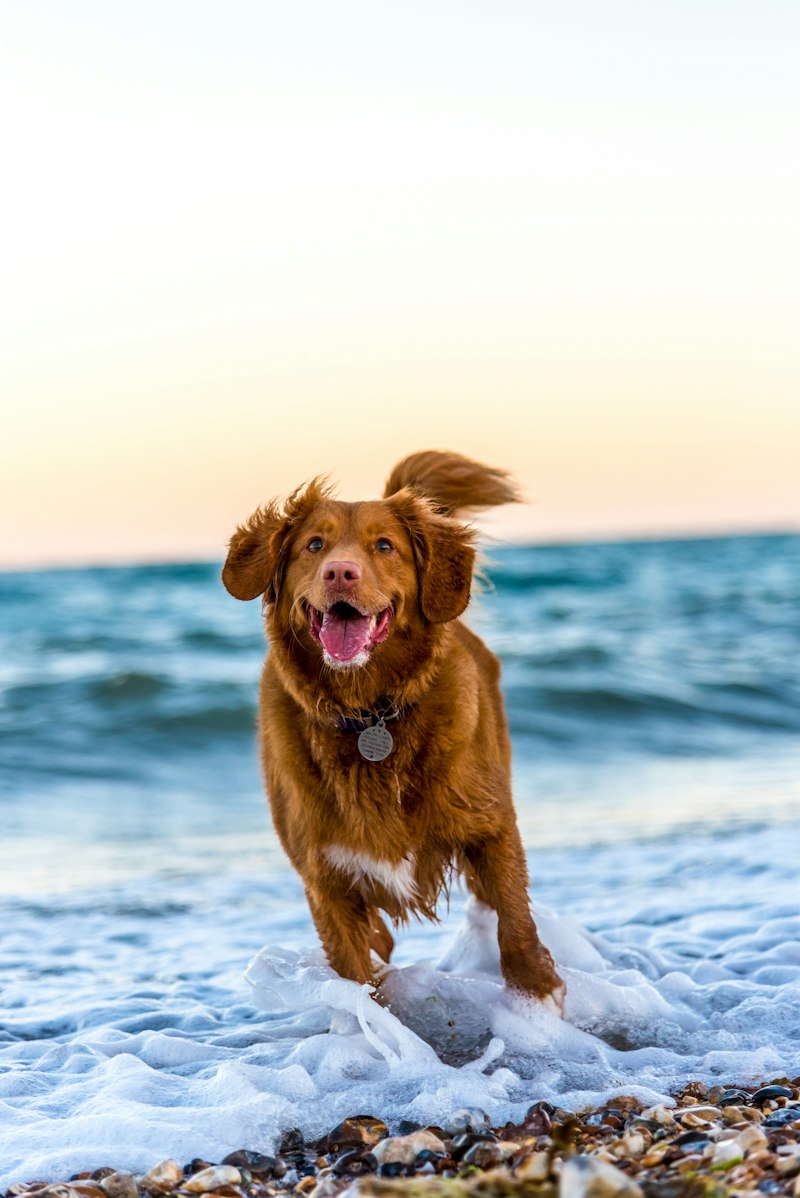
Tyrella is one of the best dog walks near Belfast — but it's longer than it looks
Tyrella Beach, just outside Downpatrick, is one of the go-to answers whenever someone from Belfast, Carryduff or Lisburn asks about proper dog walks in County Down. It's a long, wide, west-facing stretch of sand backed by a run of dunes, and on a clear day with the tide out it looks like it was built for dogs: flat, open, hardly any road noise once you're on the beach itself.
For a young, fit dog that's exactly what it is. For a senior dog, or one with arthritis, hip dysplasia or a dodgy shoulder, Tyrella is still a genuinely good option — but the honest truth is that the beach itself is the easy part. It's getting from the car to the sand, and judging how far to go once you're there, that decides whether your dog has a good day or a sore one tomorrow.
Where to park, and which bit is quieter
Most people arrive at the main car park set back behind the dunes. It's usually fine for an older dog — there's room to let them out steadily rather than scrambling over a kerb — but it does fill up on dry weekends and summer evenings, partly with other dog walkers and partly with horseboxes, because Tyrella is popular with riders too.
There isn't really a secret quiet entrance; quiet at Tyrella mostly comes down to timing rather than geography. Midweek mornings, and pretty much anything outside July and August, tend to be far calmer, which suits an older dog that doesn't love being swerved around by loose dogs or startled by a horse appearing at speed.
The dune crossing is the real test for sore joints, not the beach
Once you're parked, there's a path or boardwalk crossing over the dunes before you actually reach the sand. This is the bit that catches people out. It involves a short climb, some give underfoot where the sand is loose and dry, and occasionally a bit of a drop on the far side down onto the beach proper.
For a dog with arthritis or stiff hips, this short stretch can be harder work than the entire length of beach beyond it. Loose, dry sand gives way under the paws in a way that firm wet sand simply doesn't, and a slope that looks trivial to us can be genuinely awkward for a dog that struggles to get its hind legs underneath it. Let your dog set the pace here rather than being towed along, and if you've got a smaller or lighter dog, it's worth carrying them over the worst few metres rather than letting them flounder.
Benches are scarce — plan your rest stops before you set off
This is where Tyrella is less forgiving than somewhere like a town park. There are, generally speaking, few if any benches dotted along the beach itself — it's a natural, open stretch of sand and dune, not a promenade. Any seating tends to be back near the car park rather than out on the walk.
If your dog needs regular breaks, build that into the plan rather than hoping for a handy bench. A folded mat or old towel in the boot means you can sit your dog down on the dune grass rather than on cold, damp sand, and a short pause out of the wind in the lee of a dune does the same job as a bench would.
The shortest, kindest route for an older dog
Tyrella's main selling point — that it runs on for a long way in both directions — is also the trap for a dog that tires quickly. It's very easy to walk further out than you meant to, because the going feels easy, and only notice the problem on the way back when your dog is flagging and you're still a fair walk from the car.
The simplest fix is to pick a clear landmark close to the car park crossing — a particular dune, a stream outfall, a obvious bend in the shoreline — as your fixed turning point, and treat it as non-negotiable on the way out. Walk out and back along the same line rather than attempting any kind of loop, so you can turn for home the moment your dog slows, sits down, or starts lagging behind rather than pulling ahead.
- Stick to the firm wet sand near the waterline rather than the soft dry sand higher up — it's noticeably easier on hips and shoulders.
- Go out and back on the same line, not a loop, so turning for home is always an option.
- Treat the dune crossing as part of the walk's effort, not a free pass either side of it.
What the ground and the weather are actually like
Being open to the Irish Sea, Tyrella catches wind that you might not feel at all a few miles inland in Downpatrick or Ballynahinch, and it can feel considerably colder on the beach than the forecast suggests — worth knowing if your dog has arthritis, since cold and damp tend to stiffen joints up fast. A coat on the way back to the car isn't a bad idea for an older dog even in a reasonably mild month.
In February and through the wetter stretches of winter, expect the fringes of the car park and the base of the dune path to be soft, muddy or puddled, and the dune crossing itself can get slick after heavy rain. Tide matters too: the firmest, flattest sand — the kindest surface for sore joints — is usually found closer to low tide, while a rising tide can push you back up onto the softer, harder-going sand nearer the dunes sooner than you'd like.
Dogs, horses and seasonal rules — what to check before you go
Tyrella is shared ground. It's well used by horse riders as well as dog walkers, and an older dog that's a bit deaf or slow to react is safer kept on a lead, or at least close at heel, when riders are about rather than trusting it to get out of the way in time.
Like a number of beaches along this coast, Tyrella can be subject to seasonal restrictions on dogs during the busier summer bathing months, and signage and byelaws do change from year to year. Rather than relying on anything written here, it's worth glancing at the noticeboard near the car park on the day, so you know exactly what's in force before you let an older dog off the lead.
After a big day at the beach — what older dogs need next
Sand uses muscles a dog doesn't use on pavement or grass, and it's common for a senior dog to seem absolutely fine on the beach itself, then stiffen up that evening or the next morning. A gentle walk the following day rather than a repeat of Tyrella, and keeping an eye on how they get up from lying down, is a reasonable way to judge whether the trip was too much.
If you're based around Belfast, Carryduff or Newtownbreda and you're weighing up dog boarding Belfast owners can actually rely on for an older dog with its own routine and medication, or doggy day care near me searches keep turning up when you need a safe, calm place for a day, it's worth mentioning that we look after plenty of senior and arthritic dogs at Johnny's Doggy Hotel and are always happy to talk through what a dog like yours needs before you book.